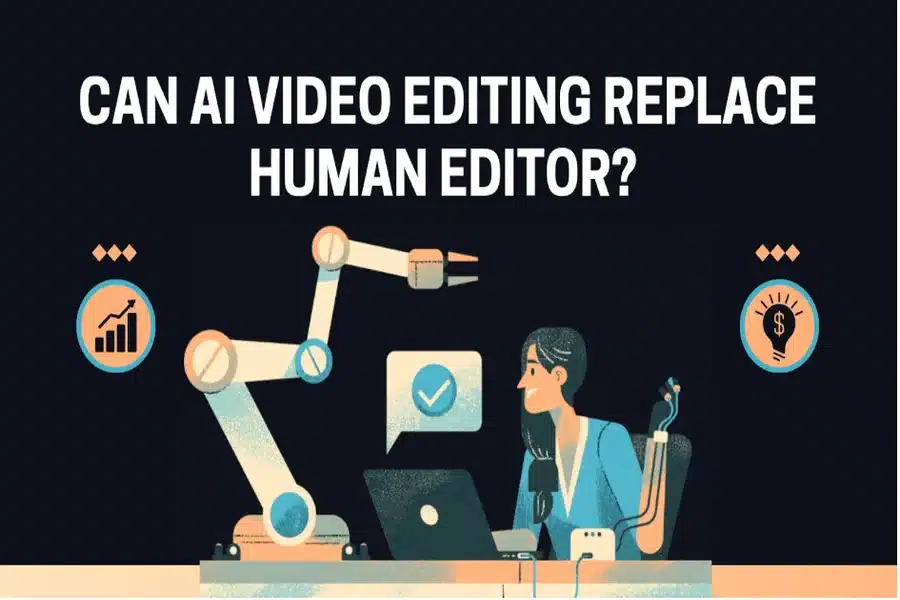
Video editing has always been an art. It is not enough to just join clips or fix the sound, but to create a beautiful story is the real work. Nowadays, AI or artificial intelligence has come a long way in the field of video editing. So the question arises, can AI replace humans?
Power of AI
The biggest advantage of AI is its speed and efficiency. It can convert hours of footage into a beautiful video in just a few minutes. This task takes a lot of time for humans to do.
AI usually does some mechanical tasks very well, such as:
- Cut out unnecessary parts of the video.
- Add simple transitions.
- Adjust the volume of the sound.
- Remove watermark from video
- Identify human faces in the video.
- Arrange the footage according to the content.
For example, sports channels now use AI to create match highlights very quickly. AI automatically finds exciting moments like goals and creates a short video with them.
AI’s Weaknesses
While AI is good at speed, it has many weaknesses in terms of understanding creativity and emotion. Editing is not just about putting together clips, it’s about storytelling. A human editor knows when to show a shot a little longer to create suspense, or when to deliver a joke well. AI, however, doesn’t understand the depth of humor or emotion.
For example, a YouTuber who edits his travel videos himself doesn’t just use clips of landmarks. He adds his personal feelings, music that fits the environment, and a certain pace that captivates the audience. AI may edit the same footage perfectly, but it lacks the emotion and charm that encourages viewers to watch it again and again.
Also, every editor has their own style, which AI doesn’t have. AI only uses the patterns that it has been taught. As a result, the videos created by AI can often seem monotonous or predictable.
AI vs. Human Editor
There are some key differences between artificial intelligence (AI) and humans when it comes to video editing. The table below highlights their key skills and characteristics.
| Feature | AI Editor | Human Editor |
| Speed and Efficiency | Extremely fast; processes hours of footage in minutes. | Slower but deliberate; prioritizes quality over speed. |
| Repetitive Tasks | Excellent at automation (cutting, transitions, syncing). | Can do these, but they are time-consuming. |
| Creativity & Storytelling | Limited; follows learned patterns, lacks originality. | Strong; adapts style, tone, and emotion. |
| Emotional Nuance | Struggles with humor, drama, and subtle storytelling. | Understands emotion and cultural context. |
| Collaboration | None; works alone. | Collaborates with clients, directors, and the team. |
| Adaptability | Rigid; relies on training data. | Flexible; can refine and adjust the vision mid-project. |
| Cost | Often cheaper, especially for quick edits. | More expensive but adds unique value. |
The Role of Humans in Video Editing
Humans are very important in video editing, because they have creative judgment that no artificial intelligence (AI) or algorithm can duplicate.
A skilled video editor knows how to make the viewer feel something through a video. He can turn a simple family video into a beautiful story or create an educational documentary from raw footage.
What a human can do beyond technical skills:
Collaboration: An editor works closely with directors, clients, and producers to understand the main idea of the video.
Flexibility: Humans can adapt to unexpected requests or new creative needs, which an AI cannot.
Trend Awareness: An editor understands cultural context. As a result, he can create videos that connect with the audience very easily.
For example, an independent filmmaker can use unique editing styles in their own short films, break up the motion, or experiment with color and sound to create a certain feel. AI can’t do such basic tasks according to its own rules.
How AI can make people’s work easier
The good news is that AI can’t replace people, but it can help. For example, an AI tool can: Automatically stitch together multiple camera angles. Suggest songs that fit the mood of the video. Time-consuming tasks like remove background from a video, noise reduction or color correction can be done with great ease.
This allows humans to focus more on creative tasks like crafting a story or capturing emotional moments more accurately. Many editors today use AI features built into their editing software. Just like a photographer uses AI to perfect a photo.
For example, I’ve seen wedding videographers spend hours sifting through footage to find the key moments in a wedding video. But they’re the ones who are responsible for finalizing the video, so that it truly reflects the couple’s story.
Future Thoughts
So, will AI eventually replace humans? My personal opinion is not entirely. Perhaps in the future, a healthy relationship will develop between AI and humans. AI will continue to get better at technical tasks, and editors will continue to explore new avenues of creativity.
Historically, every new technology, whether it’s a digital camera or new editing software, was initially seen as a threat to humans, but in the end, it made editors’ jobs easier. AI is another step in that direction.
In the future, we might see AI doing 90% of the mechanical work, while humans focus on the remaining 10% like storytelling, aesthetics, and bringing life to the video.
Last word
AI can do video editing quickly and efficiently. It can cut footage, analyze scenes, and simplify tasks in ways that humans simply can’t. But it lags behind in terms of creativity, storytelling, and emotional depth what makes a video truly meaningful. An editor is essential because of the human’s ability to connect with judgment and emotions. Therefore, it would be wrong to completely eliminate AI, as it can act as a powerful assistant to save time and speed up the work.
Ultimately, the future of video editing is not “AI vs. humans,” but “AI and humans” together. Machines may do the heavy lifting, but humans will always do the breathing work.