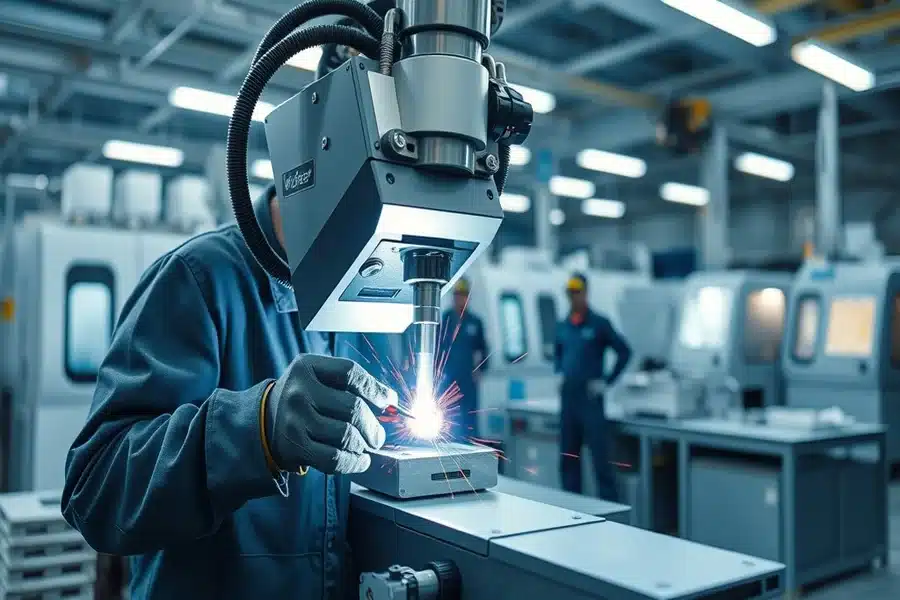
If you’re operating in any modern manufacturing environment, you’ve likely felt the pressure: faster turnaround times, tighter tolerances, rising labor costs, and an ever-growing expectation for consistent quality. These pressures make it harder to stay competitive, especially as products become more complex and materials continue to evolve. One solution gaining rapid traction is the laser welding machine—a tool that offers remarkable speed, cleaner welds, and automation-ready capability.
Across industries, from automotive to electronics, companies are shifting to laser welding not just to keep up but to stay ahead. As you explore ways to streamline production and reduce waste, understanding why this technology is in high demand can help you make more informed decisions about your operations.
Drivers of Growing Demand
Efficiency & Productivity Needs
Many manufacturers are adopting laser welding to reduce cycle times, often cutting weld durations by nearly 50%. The concentrated energy and high travel speeds mean you can complete more welds per shift, especially when paired with automation. Because the process produces cleaner joints, there’s less grinding, polishing, or corrective work needed later. This reduction in secondary work also improves throughput.
Another advantage is continuous or semi-automated operation. A laser welding machine can be integrated into automated production lines, allowing longer runs with fewer interruptions compared to manual or traditional weld processes.
Material and Design Complexity
Manufacturers today rely heavily on lightweight alloys, thin materials, and combinations of dissimilar metals—especially in automotive, aerospace, and electronics applications. Laser welding excels in these situations because it produces a very narrow heat-affected zone. You gain tighter dimensional control and less distortion during assembly, which is increasingly important as designs grow more intricate. These demands are rising alongside the global shift toward lighter, stronger, and more energy-efficient products.
Cost Savings & Quality Imperatives
Another reason adoption is growing is the potential for real cost savings. Cleaner welds lead to fewer defects, less scrap, and improved first-pass yields—each contributing directly to lower production costs. Additionally, laser welding machines require fewer consumables and often consume less energy per weld.
When you consider the cumulative savings across high-volume production, the operational advantages become even more compelling.
Industries Accelerating Adoption
Automotive & E-Mobility
The automotive sector is one of the biggest drivers of laser welding machine adoption. From body-in-white panels to EV battery pack assemblies, manufacturers rely on laser welding to meet high-volume, high-accuracy requirements. Lightweighting efforts, aluminum usage, and safety compliance are further accelerating the shift.
Aerospace & Defence
Applications in aerospace demand minimal distortion, clean joints, and high structural reliability. Laser welding machines offer the precision needed for complex assemblies and exotic materials.
Electronics, Medical & Precision Manufacturing
Micro-components, miniature housings, tiny foils, and intricate electronic assemblies rely on the high precision of laser welding machines. The ability to work on delicate materials without damaging surrounding areas makes these machines indispensable.
General Fabrication & Heavy Industry
Even traditional fabrication shops are incorporating laser welding machines to improve speed and reduce skilled-labor dependency. Automation lines also benefit from repeatable, high-speed welding.
Benefits of Integrating Laser Welding Machines
Throughput and Workflow Optimization
Laser welding offers single-pass, high-speed welding that increases production output. Many manufacturers report major improvements in shift productivity due to fewer interruptions and faster weld times. Automated workflows also become more efficient because fewer manual interventions are required.
Improved Quality and Consistency
Because a laser welding machine generates a narrow HAZ and uses a highly concentrated beam, the welds are consistent in depth, width, and appearance. This repeatability significantly reduces rework. As a secondary effect, downstream processes—such as machining or finishing—often become easier and faster.
Flexibility and Ability to Scale
Laser welding machines handle a wide range of materials and part types, allowing your production line to pivot quickly as products evolve. This flexibility is especially valuable for businesses entering new markets or adopting modern assembly techniques.
Cost Management and ROI
High-utilization environments often see payback periods between one and three years, based on reduced rework, improved throughput, and lower labor requirements. Even for mid-volume production, the long-term financial benefits are significant.
Considerations and Implementation Challenges
Up-front Investment and Infrastructure
Laser welding machines require a substantial capital investment, particularly when integrated with robotics, automation, and advanced safety systems.
Workforce and Skills Transition
Switching to laser welding means you’ll need to train operators, maintenance staff, and process engineers. Understanding laser parameters, joint design, optics care, and safety requirements is essential.
Process Fit-Up and Part Preparation
Even the most advanced laser welding machine depends on good joint preparation and fit-up. Poor alignment, reflectivity challenges, or surface contaminants can affect quality.
Integration with Existing Systems
You’ll need to ensure compatibility with existing robotics, CNC systems, sensors, conveyors, and data platforms. Proper integration determines how much value you get from your investment.
Selection and Scalability
Machine power, beam quality, automation readiness, material compatibility, and upgrade options should align with your long-term goals—not just current needs.
Why Denaliweld’s Solutions Address the Demand
If you’re considering upgrading your production environment, Denaliweld offers laser welding machines designed for modern manufacturing challenges. Their systems emphasize precision, automation compatibility, and material versatility—capabilities that support the efficiency, quality, and scalability benefits discussed above. With comprehensive support, training, and flexible machine options, Denaliweld helps you integrate a laser welding machine smoothly into your existing operations, enabling long-term operational growth.
Conclusion
The rising demand for laser welding machines signals a broader shift across global manufacturing: a need for speed, precision, consistency, and competitive efficiency. As products become more complex and production expectations continue to rise, adopting a laser welding machine can significantly elevate your capabilities—reducing waste, improving quality, and enabling modern automation strategies.
With strategic planning, proper integration, and the right equipment partner, you can harness the full value of laser welding technology. Choosing a trusted provider like Denaliweld goes a long way in ensuring that your investment delivers meaningful improvements now and positions your operations for long-term success.