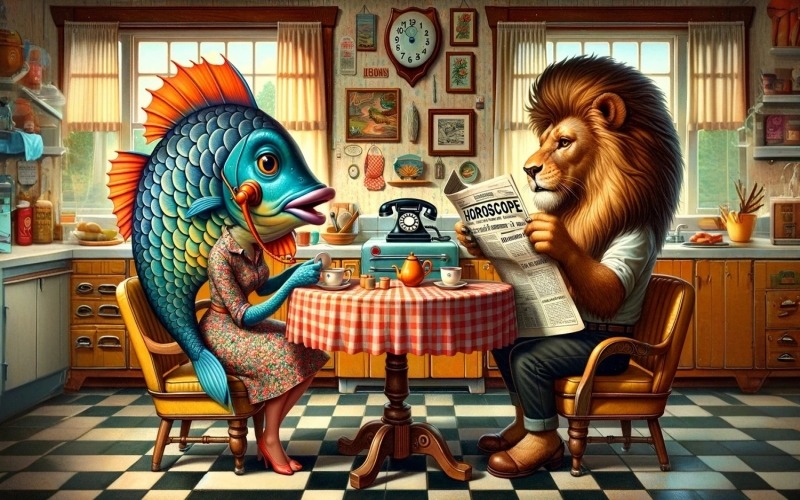
Why millennials are flocking to horoscopes and birth charts? Is it a tool for stress relief or a Harmless Belief? This article dives into the psychology behind astrology’s appeal.
Astrology has been a cornerstone in various cultures for thousands of years, evolving from its Babylonian roots to a key aspect of Hinduism. These days, astrology has found a new purpose among young people, becoming a mirror for introspection. Astrology forces us to take a closer look at who we are and how we relate to the world around us. Studying your sun sign as well as the rest of your birth chart has two useful purposes: the first is to help you identify natural strengths that you can capitalize on, and the second is to identify personal weaknesses that prevent you from realizing your desires.
Throughout the ages, astrology has played an important role in various cultures. From its origins in Babylon, it has evolved into an important aspect of Hinduism. Today, however, astrology has found a new life among the youth. It has become a mirror to help people understand themselves better.
Astrology encourages the younger generation to take a closer look at themselves and their connection to the world. Studying your zodiac sign and the entire natal chart allows you to:
- Identify your natural strengths and utilize them to achieve your goals.
- Identify personal weaknesses that prevent you from realizing your desires.
Despite astrology’s classification as a belief system rather than a scientific one, its appeal grows. A study highlighted in Science Communication (What Makes Some People Think Astrology Is Scientific?) points to an intriguing phenomenon: the suffix “ology” in astrology may contribute to its mistaken scientific credibility. Furthermore, the confusion between astrology and its scientific counterpart, astronomy, along with varying levels of scientific understanding and authoritarian beliefs, plays a role in perceptions of astrology’s legitimacy.
Astrology and Generation Z: influence on life and relationships
The influence of the Cosmos on life is a topic that causes a lot of controversy, and the opinions of young people on this matter are different. Some believe that astrology helps them find new ways to solve problems, improve relationships with loved ones and make the right choice in difficult situations. Others are more skeptical about astrology, but still recognize that reading personal daily horoscopes, like those on the PythiaGuru service, can prompt reflection on important aspects of life.
So how do you know if a person believes in astrology? Ask a question: “Is it important to know your partner’s zodiac sign?”
The fast pace of life is a reality of the modern world. We are constantly rushing somewhere, trying to do everything as quickly as possible, and because of this we experience tremendous stress.
In 1982, American physician Larry Dossey described this condition as “time neurosis” or “time obsession”. He noted that a person feels as if “time is running out, there is not enough of it” and he “has to pedal harder and harder to get everything done.” Stress from the constant rush negatively affects all aspects of our lives: relationships, eating disorders, sexual problems, somatic illnesses, and mental health disorders.
Searching for ways to relieve stress, young people are turning more often to a free tool like astrology horoscopes.
Dr. Lance B. Eliot, an expert on Artificial Intelligence (AI) delves into the intriguing realm of astrology’s prevalence and its potential impact on mental health.
The Popularity of Astrology Among Americans
A recent YouGov survey reveals a curious insight: approximately 27% of Americans, including a notable 37% of the younger crowd under 30, entertain the idea that the celestial ballet of stars and planets has a direct impact on our daily lives. Meanwhile, a significant 51% of the population remains skeptical, with the remaining 22% perched on the fence of uncertainty.
Astrology: Harmless Belief or Mental Health Hazard?
At a glance, astrology might seem innocuous. A matter of personal belief, to each their own, right? That’s the essence of the “live and let live” viewpoint.
But sometimes people can become overly dependent on astrological advice. Concerns arise about possible spikes in stress, financial indiscretion, which affects negative mental health outcomes.
A thought to chew on: Could the noticeable traction astrology gains be a reflection of our society’s collective stress levels? It seems individuals, bogged down by societal pressures, are clutching at astrology as a form of solace.
In the digital age, opinions on astrology scatter far and wide across the internet. They range from vehement criticism to fervent support. One intriguing tidbit circles around the legendary financier J.P. Morgan, who allegedly quipped, “Anyone can be a millionaire, but to become a billionaire, you need an astrologer.”
If there’s any truth to Morgan’s words, it hints at an intriguing future, especially with generative AI in the mix. Will we witness a surge in billionaires? Only time will tell.
It is important to note that astrology should not become dogma. If you read horoscopes, listen to your intuition and common sense.