

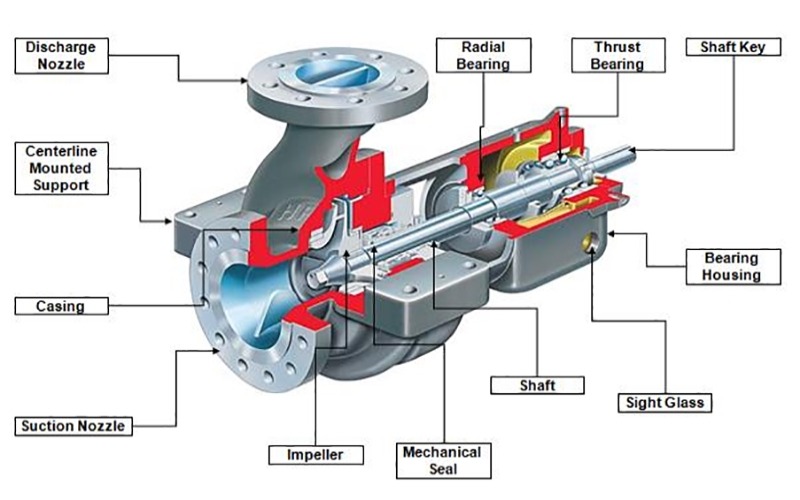

Water pumps play a crucial role in various industries and applications, facilitating the movement of fluids efficiently from one location to another. Understanding the components and functions of a water pump is essential for maintaining, troubleshooting, and optimizing its performance. In this article, we’ll delve into the anatomy of a water pump, exploring its main parts and their respective functions.
1. Housing:
The housing serves as the mainframe of the water pump, providing structural support and containing the components essential for fluid movement. Typically made of durable materials such as cast iron, stainless steel, or thermoplastics, the housing encloses the pump’s internal components and prevents leakage of the pumped fluid. It also includes inlet and outlet ports for fluid entry and discharge, respectively, as well as mounting points for installation. The housing’s design and construction play a critical role in ensuring the pump’s longevity, reliability, and resistance to corrosion and abrasion.
2. Impeller:
The impeller is a key component of the water pump responsible for generating fluid flow and pressure. It consists of a series of curved blades or vanes mounted on a central shaft, which rotates rapidly when powered by the pump’s motor. As the impeller spins, it creates centrifugal force, which propels the fluid outward from the center of the pump towards the discharge outlet. The shape, size, and arrangement of the impeller blades determine the pump’s flow rate, head pressure, and efficiency. Common materials used for impeller construction include bronze, stainless steel, and thermoplastics, selected based on factors such as fluid compatibility, abrasion resistance, and operating conditions.
3. Motor:
The motor is the driving force behind the operation of the water pump, providing the mechanical energy needed to rotate the impeller and move the fluid. Typically an electric motor, it converts electrical energy into rotational motion through the interaction of magnetic fields within the motor’s windings. The motor is housed either within the pump housing or in a separate compartment, depending on the pump’s design and configuration. It is equipped with components such as bearings, shafts, and seals to support smooth and reliable operation. The motor’s horsepower rating, speed, and power supply requirements vary depending on the pump’s size, capacity, and intended application.
Functions of Water Pump Components:
– The housing provides structural support and containment for the internal components, ensuring leak-free operation and protecting against external damage.
– The impeller generates fluid flow and pressure by accelerating the fluid radially outward through centrifugal force, facilitating efficient fluid movement.
– The motor converts electrical energy into mechanical energy, driving the rotation of the impeller and powering the pump’s operation.
Conclusion:
In conclusion, water pumps consist of three main components: the housing, impeller, and motor, each serving a distinct function in the fluid handling process. The housing provides structural integrity and containment for the internal components, while the impeller generates fluid flow and pressure through centrifugal force. The motor drives the rotation of the impeller, converting electrical energy into mechanical energy to power the pump’s operation. Understanding the anatomy and functionality of water pump components is essential for selecting, operating, and maintaining pumps effectively in various industrial, commercial, and residential applications. By ensuring proper design, installation, and maintenance of water pump systems, engineers, technicians, and operators can achieve optimal performance, reliability, and efficiency in fluid handling operations.