

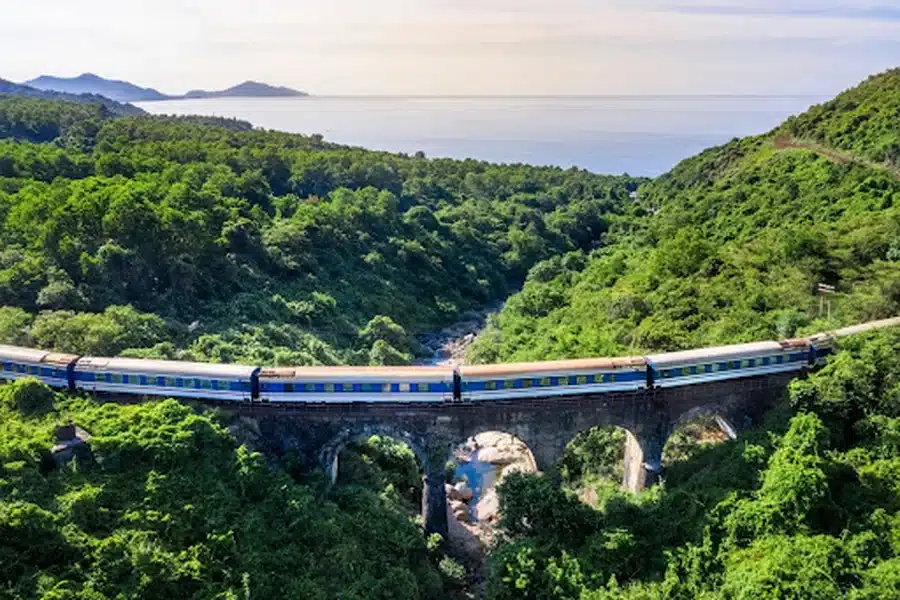

There’s a different Vietnam, one you can’t see from a plane window. It’s a Vietnam that reveals itself through the window of a train car, moving at a slower rhythm, where lush green rice paddies stretch to the horizon, where the tracks hug sheer cliffs overlooking the turquoise sea, and where daily life unfolds in its simple, beautiful rhythm. For me, traveling by train isn’t just about getting from one place to another; it’s the most authentic way to “touch” the soul of this country.
Train on Hai Van Pass – The most beautiful train journey of Vietnam Railway
But let’s be real: this romantic journey comes with its own quirks and challenges. My first time, I felt completely overwhelmed by the unknown. This is the guide I wish I’d had—all the hard-won experience I’ve gathered to help you navigate the rails like a seasoned traveler.
Step 1: Planning – Turning Complexity into Simplicity
This is probably the most headache-inducing part. Where to buy tickets? Which train to choose? Should you get a seat or a sleeper berth?
Booking train tickets in Vietnam was a constant struggle until I discovered Vexere. The official railway website was difficult to use and consistently rejected my international cards, while buying tickets at the station meant long queues and a frustrating language barrier.
Vexere provided the perfect solution for my train travel needs. Their platform simplified the entire process: the interface was in clear English, pricing was transparent, and most importantly, it accepted my international card without issue. The moment I completed the booking, a confirmed e-ticket for my train journey was in my inbox. For any traveler looking for a reliable, stress-free way to book train tickets in Vietnam, Vexere offers guaranteed peace of mind.
My advice:
- Choose the “SE” trains: These are the fastest, most modern, and cleanest trains. SE1, SE3, and SE5 travel from North to South, while SE2, SE4, and SE6 go from South to North.
- Invest in a Soft Sleeper: If you’re traveling a long distance or overnight, trust me, a soft sleeper in a 4-berth cabin is the most worthwhile investment. You’ll have privacy, a more comfortable mattress, and a good night’s sleep to be ready for the next day’s exploration.
Step 2: Onboard – The “Survival” Tips
Once you’re settled on the train, this is when practical experience really comes into play.
- Your weapon against the cold: The air conditioning on the train is famously powerful. Even if it’s 35°C outside, it can feel like winter inside. A light jacket, a sweater, or a sarong will be your savior.
- Lifeline for your electronics: Never trust the power outlets on the train. They might exist, but they don’t always work. A fully charged power bank is an absolute must-have. There’s no Wi-Fi either, so be sure to download movies, music, or books beforehand for entertainment.
- The food situation: They serve rice dishes and snacks on the train, but honestly, the quality is just average. The best strategy is to bring your own food. Some snacks, fruit, and especially instant noodles (there’s usually a free hot water dispenser at the end of each car) will make for a great meal.
- Personal hygiene: This is the biggest drawback. The toilets are usually clean at the start of the journey and will deteriorate over time. Always pack your own toilet paper, hand sanitizer, and wet wipes. A pair of slippers for the restroom is also a good idea.
- Safety first: Although Vietnam is very safe, a little caution never hurts. Keep your valuables like your passport, money, and phone in a small bag and keep it with you at all times, even when you’re sleeping. If you’re in a sleeper cabin, remember to lock the door from the inside at night. It’s not just for security against theft, but also to prevent other passengers from accidentally trying your door in the dark.
Step 3: The Reward – Watching Vietnam from Your Window
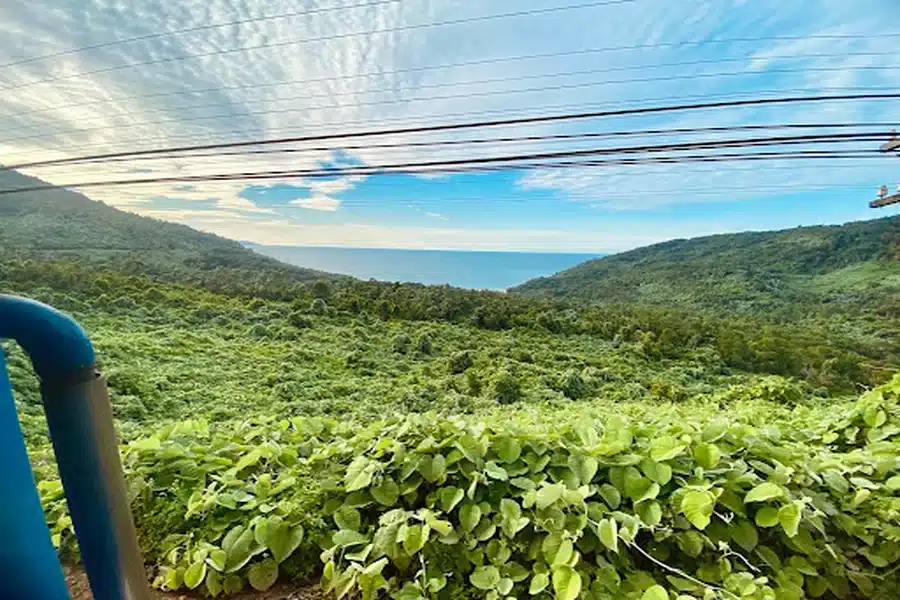
And this is why you chose the train. The most beautiful, spectacular stretch of the entire North-South railway is the train from Da Nang to Hue through the Hai Van Pass. Here, the train slows to a crawl as it snakes along the mountainside, with jungle-clad cliffs on one side and a jaw-dropping panorama of the turquoise East Sea on the other.
Crucial Tip:
- Traveling from Da Nang to Hue (Northbound), choose a seat or berth on the right side.
- Traveling from Hue to Da Nang (Southbound), choose a seat or berth on the left side.
This will give you the most stunning, unobstructed view of the sea. When booking, you can often see the carriage layout to select the exact spot you want.
A train journey in Vietnam is not a 5-star luxury experience, but what it offers is infinitely more valuable: authenticity. It’s a lesson in patience, a feast for the eyes, and a chance to see the country unfold at a human pace. So embrace the bumps, share a smile with a stranger, and let the rhythm of the rails connect you to the true heartbeat of Vietnam. Your adventure is waiting.