

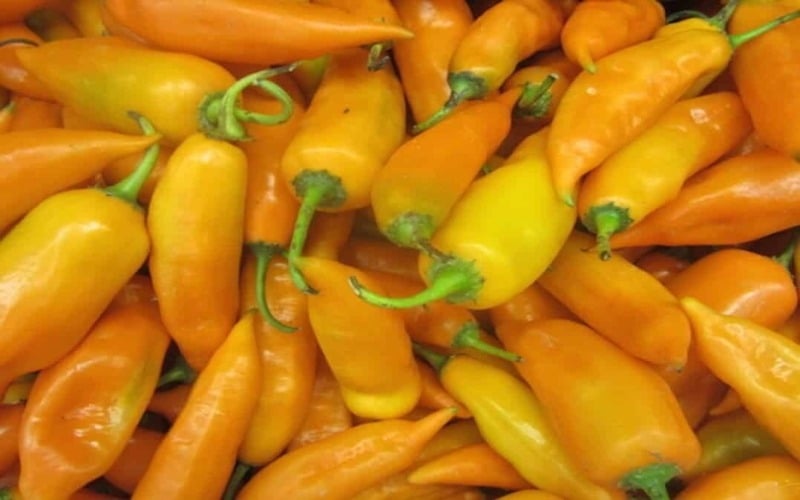

Whether you’re a chef or simply enjoy cooking, chances are you’ve encountered yellow hot chili peppers in your culinary escapedes. If not, don’t fret— you’re about to gain some insights into these flavorful ingredients.
Yellow hot chili peppers are from the Capsicum pepper plant and can be incorporated into your dishes either in their fresh or dried forms. Packed with vitamins, antioxidants, and minerals, these peppers boast higher antioxidant benefits compared to their green counterparts, making them a popular choice among many.
In this article, we delve into the various types of yellow hot chili peppers, shedding light on why they could be the perfect addition to your next meal.
Popular Yellow Hot Chili Pepper Varieties
Yellow peppers come in a range of varieties, each differing on the Scoville scale. The Scoville scale is a useful tool for gauging the spiciness of peppers. It focuses on their heat levels and ranks the heat intensity in Scoville Heat Units (SHU). The spiciness is attributed to a chemical compound in the peppers called capsaicin and the Scoville units are determined through the Organoleptic test.
During this test, capsaicin oil is extracted from dried peppers to quantify the heat. The capsaicin extract is then handed over to a panel of five testers who establish the heat level.
In the following sections, we explore the Banana, Hungarian Wax, and Lemon Drop pepper varieties.
I. Banana Pepper
The banana pepper is a medium-sized member of the chili pepper family that starts off bright yellow and turns into a mixture of orange, green, or red when ripe. It has a sweet, mild, or tangy taste and a heat level of between 0 and 500 Scoville units.
The best use for this variety is in raw dishes. Here are some best-use scenarios:
- Garnishing sandwiches
- Adding a hot kick to Greek salads
- Serving them warm alongside cheeses and Italian sausages
- Complimenting the flavors of jalapeno green peppers
II. Hungarian Wax Peppers
The Hungarian wax pepper, also known as Chile Hungaro, is native to North America. Typically measuring 10-15 centimeters, these peppers are harvested when yellow. They turn orange and then red upon maturity.
Unlike banana peppers, Hungarian wax peppers are longer and fatter and have a Scoville heat level of 1000-15000 SHU. Variants include TV paprika, Szentesi paprika, Lecso paprika, and Bogyiszlói paprika, which is the hottest among them.
III. Lemon Drop Pepper
The lemon drop pepper belongs to the baccatum species. It is a cone-shaped variety of yellow chili peppers, measuring around 70 mm in length and 12 mm in width.
Here are some other notable characteristics:
- The lemon drop pepper plant has dark green, narrow leaves
- The petals are whitish-green with yellow-green spots
- Lemon drop peppers are high-yielding, producing around 100 fruits annually
- They measure between 30,000 and 50,000 SHU on the Scoville scale
Regional variations include the aji lemo from the Andes, aji Mochero native to the northern region of Peru, and aji Arnaucho from the Norte Chico region of Peru.
Health Benefits of Yellow Hot Chili Peppers
Yellow hot chili peppers offer several health benefits, including:
- Digestive Tract Support: Research shows that capsaicin acts as an anti-irritant, contrary to common beliefs that individuals with ulcers should avoid spicy foods.
- Metabolism Enhancement: Spicy peppers, including yellow ones, contribute to an improved metabolic rate. This happens by stimulating the body to produce more heat and this metabolic boost can have positive implications for overall health.
- Provision of Important Minerals: Yellow chili peppers are a good source of vitamins A and C.
- Pain Relief: Topical applications of capsaicin have been used for pain relief for people with arthritis and neuropathic pain.
Key Takeaways
The main yellow pepper varieties are Banana, Hungarian Wax, and Lemon Drop peppers; each has a distinct flavor profile and heat level on the Scoville scale. Yellow peppers provide digestive support, and metabolism enhancement, and are rich sources of essential minerals like vitamins A and C. It is vital to exercise caution when handling yellow peppers in the kitchen. Start small and gradually adjust the heat to achieve the best results.
Growing And Harvesting Yellow Hot Chili Peppers
Let’s now share some insights on what it takes to grow and cultivate yellow chili peppers successfully:
- Moisture content: Maintaining adequate moisture during the blossoming stage is crucial since it prevents flower drop. In the long run, this maximizes your harvest and contributes to a robust yield.
- Watering practices: We recommend that you increase the water supply just before harvesting to bring down the spiciness of the peppers.
- Nutrition: Providing the pepper with phosphorus and potassium-rich fertilizers is advisable as these elements support fruit development.
- Environmental considerations: Always shield your peepers from excessive heat. Temperatures exceeding 105°F can lead to sunburns and lower the quality of the peppers.
- Harvesting: Harvesting should occur when the peppers reach their full size and display mature coloration. This process should take place 60-90 days after planting.
Cooking Tips
Yellow hot chilies can be combined with fresh tomato-based sauces, corn, poultry, fish, onions, beans, mild cheeses, lentils, meat stews, sautés, and even sausages. You can even grind them and add them to your pizza pepper or curry powder.
Whatever you decide, it’s always important to exercise caution as the heat intensifies the more you cook them. We recommend that you start small and gradually adjust to taste as you go on. For that distinctive chili flavor, consider sautéing the peppers in oil and using the infused oil for cooking. This process also extends the shelf life of the oil.
Use your yellow chili peppers in recipes like Spicy Mango Salsa, Yellow Chili Chicken Curry, Spicy Pineapple Shrimp Skewers, Yellow Chili Pepper Hummus, Thai Yellow Chili Noodles, Yellow Chili Mango Sorbet, and Spicy Yellow Chili Cornbread.
Bottom Line
In conclusion, we recommend that consider giving yellow hot chili peppers a try if you haven’t already. These peppers are packed with antioxidants and vitamins and offer diverse health benefits. Their versatility also extends to various dishes, giving you the creative freedom to explore how you incorporate them into your recipes.
If you want to learn more about yellow hot chili peppers or purchase fresh and ethically sourced produce from FAVE Produce, you can check out our product pages. We have a wide selection of fruits, herbs, spices, and vegetables that we’re sure would be of interest to you.